16,777,216 colours.Each a discrete art object. Each a name sealed once, and only once.
The PIXEL Project deconstructs the 24-bit RGB spectrum into its constituent elements. Every hexadecimal coordinate from #000000 to #FFFFFF represents one discrete registered colour, sealed once and only once to an immutable on-chain registry.
Ethereum Block 10,150,399 · 146 historic colours
Polygon Mainnet · ERC-721 with ERC-2981 Royalties
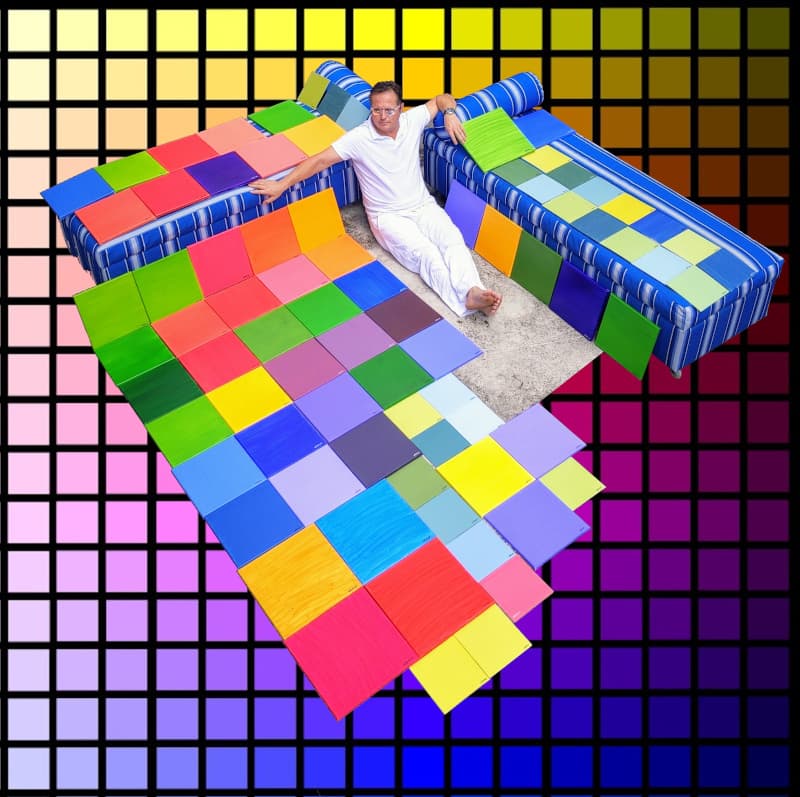
Eight-bit and every legacy colour — oil on canvas 60″ × 60″ · twelve-bit — oil on canvas 36″ × 36″ · sixteen-bit — archival pigment print 24″ × 24″. Included in the price.
“A colour is named once and the token is the security that the hex colour code and name are set, once and only once.”
In a medium built on mutable databases, the covenant is a one-way threshold. Once a colour is proposed, validated, and registered to its hexadecimal coordinate, that name can never be reassigned, renamed, or renegotiated by anyone, including the artist.
The hex coordinate is the artwork. The physical oil-on-canvas painting is its tactile body. The blockchain record is the proof that the coordinate and its title are sealed permanently.
The Colour Studio
Traverse the 24-bit RGB gamut. Each point in this two-dimensional projection corresponds to a discrete integer between 0 and 16,777,215. Propose a title to register the coordinate.
16,777,216 colours. Token only. The full spectrum. Slide to any colour.
24-bit Gamut Controller
HSV: (41°, 10%, 100%)Propose Colour Title
Submit a proposed title for this coordinate. The entry is recorded for administrative review. If validated, you will receive a secure portal link to complete registration and physical delivery details.
The colour sets the value. The canvas is added.
Each colour is priced on its own cultural weight — what it is recognised as, and what it is called. There is no formula that produces these numbers. What follows is the structure.
The 8-bit palette of 256 colours — and every colour of the 2020 registry and the 2020 Black and White pair, whatever their place in the spectrum. Hand-signed, with a verified certificate of provenance.
The colours of the 4,096 twelve-bit palette, less those already carried by the 8-bit set. Hand-signed.
The colours of the 65,536 sixteen-bit palette, less those carried by the sets above.
The remaining colours of the 24-bit spectrum exist as tokens alone. Nothing physical is made.
There are no choices of size, and no add-on for the work — it is included in the price of the pixel. Shipping is the only thing added, agreed with you before the sale. The surface follows the colour: you do not select it, and it cannot be swapped.
The surface is decided by the colour, so there are no sizes to choose. The work is included in the price of the pixel; only shipping is settled separately, case by case.
The eleven archetypal colours that every language names — black, white, red, green, blue, yellow, orange, purple, brown, pink and grey — are held. They are not for sale. Collection of artist.
A colour is named once. The token is the proof that the hex code and the name are set, once and only once. Nothing can change them afterwards — not a marketplace, not a platform, not the artist. That is why a name has value: every other named colour in commerce can be revised or withdrawn. This one cannot.
146 Colours. Sealed 27 May 2020.
The 146 colours registered on 27 May 2020 are the founding record of the entire project.
COLOR holds the hex. 146 slots, sealed on 27 May 2020 and alterable by no one — no owner, no administrator, no proxy, no upgrade path. That absence of control is the guarantee: in a medium built on mutable databases, it is a record that cannot be rewritten or backdated by anyone, including the artist.
The names attached to those hexes belong to an earlier, off-chain layer of the same project. The new registry carries naming on-chain: there a name, once issued to a colour, is sealed to it and can never be reassigned.
Those 146 colours are re-claimed in the new registry, not moved. Nothing was migrated or edited: the original record stands untouched on Ethereum while the living registry carries the project forward on Polygon.
The new registry keeps the same one-way covenant. Once a colour is issued and a name sealed to its hex, that name can never be reassigned.
Practice Preceding CryptoPunks
Robert Jennings's digital art practice predates CryptoPunks (June 2017) by approximately twenty years, beginning with his curriculum at the Michaelis School of Fine Art in 1992 and his 1997 adoption of the name eArtist.
Precedence Over Art Blocks & Christie's Sale
The COLOR registry predates Art Blocks (27 November 2020) and the Beeple Christie's sale of Everydays: The First 5000 Days for $69,346,250 on 11 March 2021 by nine and a half months. COLOR is not an image token but a colour registry — the hex value itself is the token, which makes it a different kind of object from anything else minted in that period.
The Tradition of the Colour Plane
Naming a single colour — giving it a fixed identity, a date, and a record of provenance — is a continuation of twentieth-century painting, not an administrative or commercial act.
Josef Albers
Homage to the Square (roughly 2,000 paintings, 1950–1976). Interaction of Color, Yale University Press, 1963.
“In visual perception a color is almost never seen as it really is — as it physically is. This fact makes color the most relative medium in art.”
“One and the same color evokes innumerable readings.”
Piet Mondrian
De Stijl / Neoplasticism from 1917. Composition with Red, Blue and Yellow, 1930, Kunsthaus Zürich. Composition with Yellow, Blue and Red, 1937–42, Tate.
“I then told him that we were looking for a different harmony; he said there was only one.”
Kazimir Malevich
Black Square, 1915, State Tretyakov Gallery, Moscow. First shown at The Last Futurist Exhibition 0.10, opening 19 December 1915, hung in the “red corner”. First catalogue title: Quadrilateral. Epithet: “zero of forms”.
“In the year 1913, trying desperately to free art from the dead weight of the real world, I took refuge in the form of the square.”
Alexander Rodchenko
Pure Red Color, Pure Yellow Color, Pure Blue Color, 1921, exhibited in 5x5=25, Moscow, September 1921. Three separate canvases, each titled with the name of its colour.
“I reduced painting to its logical conclusion and exhibited three canvases: red, blue and yellow. I affirmed: it's all over. Basic colors. Every plane is a plane and there is to be no representation.”
Yves Klein
Entered his blue period in 1957. On 19 May 1960 he registered the IKB process with the French national industrial property office (INPI), envelope Soleau no. 63471.
“Blue has no dimensions, it is beyond dimensions.”
Ad Reinhardt & Blinky Palermo
Ad Reinhardt: Abstract Painting, 1960–66, Guggenheim. From 1956 working solely on five-foot dark matte squares (“the last paintings”).
Blinky Palermo: To the People of New York City, 1976, Dia Art Foundation. Forty painted aluminium panels.
Robert Jennings (eArtist)
Born Nottingham, England, 1971; raised in South Africa. Educated at Michaelis School of Fine Art, University of Cape Town, 1989–1992. South African theoretical artist with 34 years of practice.
Introduced and tutored digital art and photography to the academy in 1992, investigating how the pixel might replace the physical brushstroke as the fundamental atom of contemporary painting.
In 1996 he formulated Reactivism, an ongoing body of work described in his own words as following in the footsteps of Action Painting. In 1997 he adopted the name eArtist and composed the founding text of the project, envisioning works of art with an infinite lifespan, streamed into homes and boardrooms.
Chronology of Practice (1989–2026)
Environmental Responsibility
Every registered colour supports environmental restoration. Contributions are directed toward carbon offset through C2Zero, reforestation with OneTreePlanted, and marine reef rehabilitation via the Beyond Coral Foundation.